


Hello and welcome back to as seen on !
In today’s edition, newsletter contributor and SocialGlass founder Maxine Marcus returns for her column “you are what you scroll,” a cultural digest of what various Gen Z audiences are really watching across their social feeds.
YOU ARE WHAT YOU EAT SCROLL
I’ve recently been noticing a lot of talk about the end of monoculture, and how personalized feeds are making shared context increasingly difficult to find. It’s true, we share fewer media channels, cultural touchstones, and brand experiences. But perhaps we just need to change the definition of “monoculture.” Beyond the obvious mass moments, shared culture now shows up through recurring content structures: different creators, categories, references, and points of view expressing the same underlying desires, tensions, and behaviors.
So I analyzed the social feeds of 100 Gen Zers to see which tensions and behaviors were showing up across otherwise very different feeds. Here are the top three.
For today’s column, we looked at the highest-signal likes, saves, and shares from the past six months across the social feeds of 100 Gen Zers, ages 18–28, spanning 46 states and interests from beauty and gaming to sports and everything in between.
1. Smarter buying and consideration
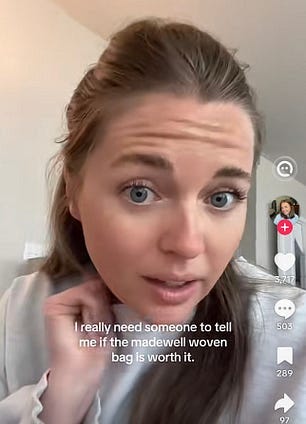
Across the feeds we analyzed, product content is shifting from “look what I bought” to “here’s how I decided whether it was worth buying.” Increasingly, consumers are comparing formulas, tracking cost per use, testing products over time, waiting out impulses, and openly evaluating what they would sacrifice for a cheaper alternative.
6.4% of analyzed posts explored buying considerations, with these posts particularly likely to be saved or favorited.
Across different feeds, that looked like:
Constant beauty-product comparisons. A creator tests whether a $15 Ulta self-tanner can replace her $60 Loving Tan favorite, while another compares a $12 L’Oréal serum with a $62 Kérastase version, ultimately preferring the cheaper product without pretending the formulas are identical.
Thrifting as an alternative to buying new. One creator teaches viewers the exact Vinted keywords and brands to search for instead of buying trending fast-fashion pieces. Another accesses Celine, Chanel, Bottega, and Ralph Lauren through luxury resale.
Demanding proof beyond the first impression. One creator recommends only products she has repurchased more than five times. Another compares Ballerette flats with Chanel after months of daily wear, showing exactly what the lower price does and does not buy.
Reducing the risk before committing. Sephora minis are evaluated by price, quantity, and usefulness.
Installing personal guardrails around desire. One creator uses a two-week waiting period to see which items survive the initial impulse.
Crowdsourcing the consideration set. A creator wants a $160 Madewell bag but asks whether it is truly worth buying, while publicly asking Quince to make an alternative.
Looking for the formula tradeoff. A creator notices that an Eva NYC hair mask became smaller and more expensive, then investigates how the formula changed before deciding whether the new version still deserves a place in her routine.
“How to under-consume like a pro:” Running wish lists, repeating favorite routines, and shopping for proven silhouettes turn “underconsumption” into curation.
TL;DR: We’re seeing fewer hauls and more product audits. Recession indicator? Maybe. A more skeptical consumer? Definitely.
2. Gen Z is redefining what ambition is for.

Over the past few years, there has been no shortage of headlines about Gen Z’s relationship with work. Our feed analysis validates the relationship between work and life as an ongoing shared theme across our cohort. Posts move between gratitude for opportunity, anxiety about maximizing it, resistance to ambition’s demands, and a desire to make room for a life outside work. The shared sentiment: I want to be ambitious without letting ambition consume my life. Quality of life above all. “Lifemaxxing,” if you will.
6.2% of analyzed posts explored ambition, its demands, or making room for a fulfilling life beyond achievement—and these posts were particularly likely to be reposted and rewatched.
Here’s how the tension between achievement and actually enjoying your life showed up across student feeds:
A USC pre-med student reframing an exhausting schedule as something to be grateful for: your tiring routine is someone else’s dream.
A lecture-hall post about supportive parents’ trust being the exact reason failure feels impossible. The caption: “Pressure is a privilege.”
A master’s thesis losing a fight to a League of Legends match notification. Real.
Here’s how the bigger aspiration—a life with enough space to actually feel like a life—shows up:
“Activity maxxing because there’s more to life than my degree” becomes a montage of skating, swimming, concerts, sports, beaches, and whatever hobby comes next.
One creator realizes her entire 9-to-5 week has been blurring together, so she starts planning activities on ordinary weekdays instead of waiting for the weekend to live.
A self-improvement creator argues for having hobbies you are terrible at. Tennis becomes practice in enjoying something without immediately mastering it.
I find this especially important. Gen Z has been branded the most anxious generation. We’re overstimulated, ADHD-scrolling through an awful job market, and scared to watch the news. But amid all the proverbial “doom and gloom,” these posts point to something hopeful: not a rejection of ambition, but an attempt to build a life in which achievement, passion, self-expression, and joy can coexist.
3. The right person “getting it” is the point: don’t we all really just want to be understood?
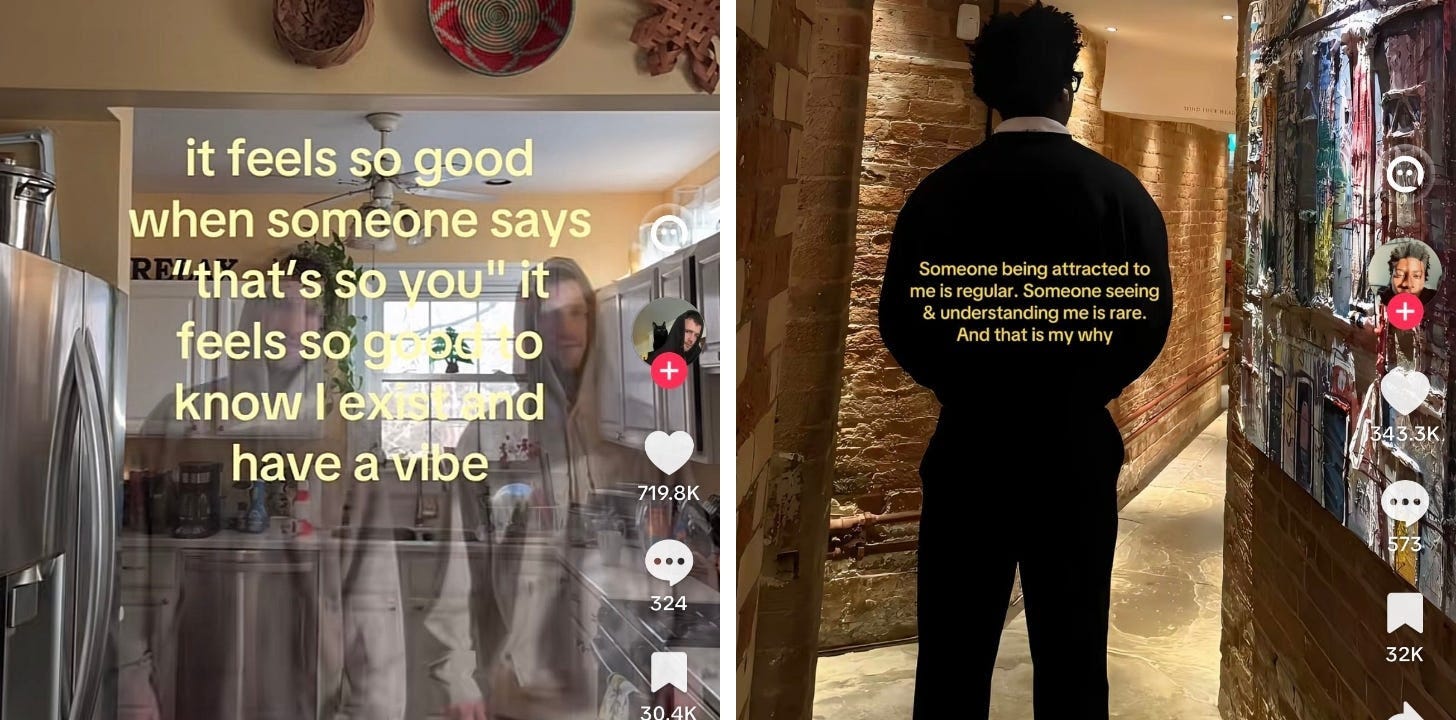
Across feeds, connection is increasingly measured by how specifically someone recognizes you. One post captures how good it feels to hear “that’s so you,” because it confirms that you “exist and have a vibe.” Another puts being understood above being desired.
There is SO much value in a reference that most people may not understand, as long as the right person does. And paradoxically, a post made for “the one person who gets it” can reach many precisely because it knows who it is for.
The broader friendship and social-life category accounts for 4.5% of all analyzed posts, and 3.6% centered on being understood, recognized, or connecting through shared references. Among the corresponding sender-post records, 42% carried a share marker, 41% a repost marker, and 42% a rewatch marker. After balancing each contributing sender equally, the repost figure was 39%.
Across different feeds, this looked like:
A romantic gesture involving a hoodie and fishing hat that only makes sense if you recognize the scene from Starstruck. Getting the reference is the compatibility test.
Friends saying the exact same stupid thing at the same time.
A list of architecture creators becoming an unofficial educational lineage. Knowing the names means you learned through the same corner of the internet.
Posting a Story for one specific person, compared to Gatsby throwing parties in hopes that Daisy notices.
Two friends cycling through niche quotes and memes, because the fun is finding someone who understands every reference.
Best friends skipping greetings entirely, because their chat is one endless stream of venting and sending TikToks.
In fragmented culture, specificity is what makes content “relatable” (buzzword alert). Dare I say, the only way. We may no longer all get the same references, but we increasingly recognize the same feeling of wanting someone else to get ours. Maybe that's where shared culture lives now.
If you want to learn more, reach out at maxine@socialglass.ai
Methodology & More About Me

What is SocialGlass? The methodology behind this column
SocialGlass is a social intelligence company that analyzes the posts specific audiences are engaging with in real time, straight from their social media feeds. Think of us as a microscope into relevant social spheres at scale.
Our network of respondents opts in to share their social behavior/engagement with us. We build customized audiences for brands, then provide deep insights into the cultures, content, behaviors, products, trends, & creators that matter to them.
Loved this!
Another one!